
Empire’s Mirror: Masculinist Violence in Lord of the Flies
Updated: Jan 21
Unravelling the false colonial binaries of rationality/passion and civility/savagery, we reveal the heart of masculinist, colonial violence that undergirds the boys's descent into bloodlust on the island which functions as a microcosm for British/Western civilisation.
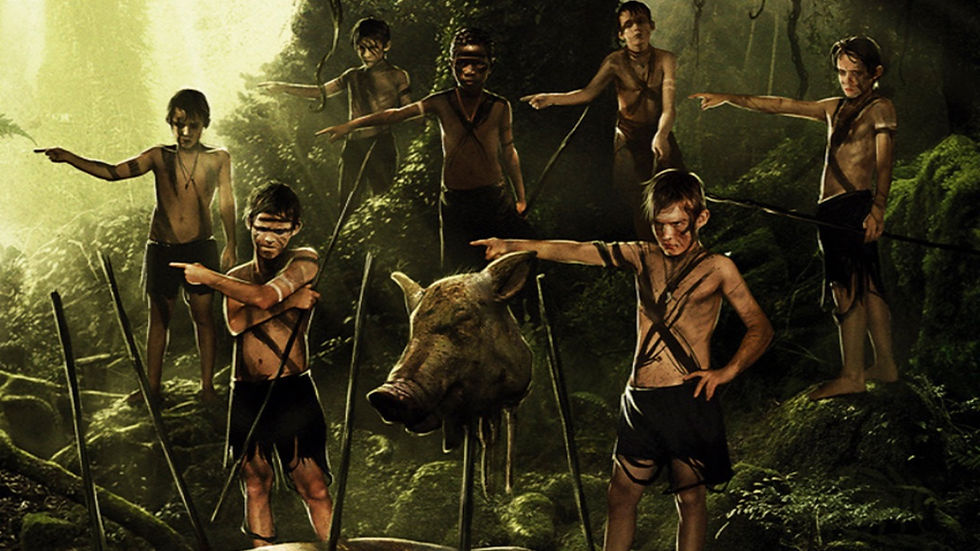
William Golding’s Lord of the Flies is frequently interpreted as a universal fable regarding the innate depravity of man and the fragility of civilisation. However, a critical examination of the text through the lenses of gender and post-colonial ideas reveals that the 'darkness of man’s heart' depicted by Golding is rooted in a crisis of British imperial masculinity. This article argues that the violence on the island is not a regression to a primitive state or a cautionary tale against man's putative evil, but rather a re-enactment of the colonial dominance and martial violence inherent in the boys' British enculturation. By analysing the sexualised violence against the sow, the racialised imagery of 'savagery', and the eventual arrival of the British naval officer, this study posits that the boys do not lose their civility; rather, they unveil its centre of masculinist violence.
William Golding stated that the theme of Lord of the Flies was 'an attempt to trace the defects of society back to the defects of human nature'. Written in the shadow of World War II, the novel suggests that social structures cannot contain the evil inherent in the individual. However, to view the boys’ descent into violence as merely a universal biological regression ignores the specific cultural conditioning they bring to the island. As David Spitz argues, the boys 'did not spring up full-blown... [they] were the carefully chosen products of an already established middle-class society' and brought their civilisation with them. The boys are products of a stratified, imperialist, and patriarchal society. Stefan Hawlin notes that the text is defensive about the surrender of the British Empire, attempting to restate old myths of white enlightenment versus black savagery. Consequently, the violence that erupts on the island must be problematised not as the absence of civilisation, but as the inevitable result of a specific type of masculinist and colonial socialisation/civilisational identity.
The Colonial Gaze and the 'Right of Domination'
The premise of the novel relies heavily on the subversion of R.M. Ballantyne’s 1857 novel The Coral Island, a text that championed Victorian optimism and the inherent superiority of English boys. Golding’s characters arrive on the island carrying the baggage of Empire. Upon climbing the mountain to survey their territory, their reaction is one of ownership and domination: 'Eyes shining, mouths open, triumphant, they savored the right of domination'. Ralph explicitly claims the territory with the imperial declaration, 'All ours'.
This attitude mirrors the colonial act of claiming land, viewing the environment not as a place of coexistence but as a subject for rule. Jack asserts this imperial superiority explicitly: 'We’ve got to have rules and obey them. After all, we’re not savages. We’re English; and the English are best at everything'. As Hawlin observes, the boys act as 'little colonisers', replicating the administrative structures of the Empire—a parliament, a system of rules, and a clear distinction between the civilised self and the savage other. Their violence is not a deviation from their culture but a manifestation of their misguided belief in their 'right of domination'.
The False Binary: Constructing the 'Savage' Other
As putatively rational, civilised order disintegrates, the text employs the language of colonialism to describe the boys' moral decline. The regression of the children is framed as a descent down a hierarchy of peoples, moving from British civilisation toward a racialised 'other'. When Piggy, the voice of rational Western science, confronts the hunters, he explicitly juxtaposes whiteness with law, and blackness with violence: 'Which is better—to be a pack of painted niggers like you are, or to be sensible like Ralph is?'. Hawlin argues that this scene reflects white fears of insurgent nationalism during the era of decolonisation, specifically echoing British anxieties regarding the Mau Mau uprising in Kenya.
The use of masks and 'dazzle paint' allows the boys to shed their 'Englishness', but Golding frames this liberation as a transition into a terrifying, racialised savagery. The text presents the boys’ violence as a 'liberation into savagery', yet this savagery is painted from the 'paint-box of Empire myths'. The horror the novel invites the reader to feel is derived from the spectacle of white, middle-class boys turning into 'natives'. This perspective reveals a colonial anxiety: that without the rigid imposition of British rule, the white man might regress to the level of the colonised subject. However, this 'savagery' is shown to be a constructed, even dramatic performance; Jack's tribe uses the mask to hide 'liberated from shame and self-consciousness', allowing them to enact the violence their culture usually delegates to its military. There is thus, no natural, a priori existence of the division between civilisation/rationality and savagery. Instead, there only exists a British/coloniser's construction to justify the brutal intrusion and plundering of foreign, exoticised and racialised lands and bodies.
Masculinist Violence and the Sexualisation of Power
The violence in Lord of the Flies is inextricably linked to the performance of hyper-masculinity. The struggle for power between Ralph and Jack is not merely political but an aggressive contest of manhood. Jack, who represents authoritarian man, finds his power in the 'brown swell of his forearms' and the capacity to inflict pain. His transition from choir leader to savage chieftain is marked by a shift from the authority of rules to the authority of force.
This masculinist violence reaches its nadir in the killing of the sow, a scene depicted with explicit sexual imagery that equates hunting with rape. Golding describes the hunters as being 'wedded to her in lust'. The assault is graphic and gendered: 'Roger found a lodgment for his point and began to push till he was leaning with his whole weight... the terrified squealing became a high-pitched scream'. The climax of the hunt is celebrated with the boys being 'heavy and fulfilled upon her', an euphemism for the fruition of (blood-)lust upon this violent, desecrating rape-like assault on the pig, and by extension, the natural world.
Robert White argues that this scene demonstrates a 'male lust for conquest and destruction of life'. The sow, a figure of 'deep maternal bliss', is destroyed by a phallic assertion of dominance, symbolised by the stick 'sharpened at both ends'. This act is not necessary for survival; it is a ritualistic assertion of masculine power over the feminine and the natural world. The violence is a 'pagan initiation' where the blood of the kill validates the boys' status as hunters and men. It signals a move away from the 'world of longing and baffled common-sense' represented by Ralph toward a world of 'fierce exhilaration' and tactical violence.
The Adult World: The Real Source of Violence
Golding suggests that the boys’ behaviour is a mirror of the adult world they left behind. The irony of the novel’s conclusion serves to indict the very civilisation the boys tried to emulate. When the naval officer arrives, he chides the boys for failing to maintain British standards, remarking, 'I should have thought that a pack of British boys... would have been able to put up a better show than that'. He views their tragedy as mere 'fun and games', and his remarks reveal an uncritical belief in the moral and cultural supremacy British civility; greatly dissonant with the context of war that explains his (and the boys's) presence on the island in the first place. His language of performance "a better show than that", further suggests that British civility is only a contrived appearance that masks the brutality of their colonial pasts, of their brutish involvements in war and bloodshed abroad. After all, the boys too are labelled as a "pack", a collective noun that aligns the boys more closely with animals.
However, the officer himself is a masculine warrior, armed with a revolver and commanding a 'trim cruiser'. As David Spitz observes, the officer represents 'force writ large'; the boys are not being rescued from violence, but are merely being transferred from the 'Lord of the flies writ small' to the 'Lord of the flies writ large'. The cruiser is engaged in a nuclear war, a catastrophic manhunt far more deadly and brutal in scale than Jack’s pursuit of Ralph.
So, does the civilisation/savagery divide still stand? No, for it is merely a Western construction that masks the brutality of British colonial conquest while reinforcing the otherness and hierarchies of difference that justify the conquest of foreign lands, bodies and environments. The boys did not fail to act like British adults; they succeeded too well. The 'civilisation' the officer represents is 'embedded in man's nature' and includes war and destruction as convention. The boys' violence was not a deviation from their culture but a distillation of its martial and imperialist ethos. The officer, like the boys, is a hunter, and his ship is a weapon. The 'darkness of man's heart' that Ralph weeps for at the end of the novel is not an external savagery found in 'natives', but the internal violence of his own civilisation.
Conclusion
Lord of the Flies serves as a complex critique of the Western myths of civilisation and masculinity. While Golding utilises the 'myth of the desert island' and the Christian concept of the Fall, the text ultimately reveals that the 'beast' is inherent in the colonial and patriarchal structures the boys inherited. The violence they enact—racialised in its imagery and sexualised in its execution—is a reflection of the 'perishing civilization' from which they came. By problematising this violence, the novel suggests that the true horror is not that the boys became savages, but that they remained, in the most brutal sense, British gentlemen.


Comments